
Writing dialogue is a lot easier for students when they have a character to speak for, and a funny picture gives them one. Picture a giant Great Dane standing over a tiny chihuahua, staring straight down at it. What is that chihuahua thinking right now? That one picture started a point of view lesson with my class, and it turned into one of their favorite writing activities.
We were working on voice in our writing, and on figuring out point of view from voice and descriptive words. I showed my students a picture of a tiny chihuahua staring up at a giant Great Dane standing over it, with this caption:
Wow! You’re big!
PLEASE don’t eat me! I’m not a squeaky toy! I’m not a snack! I’m just a tiny chihuahua!
They could tell me the little dog would be the one saying the first caption. Then I asked if it really told a story or helped describe the details of the picture. (Thankfully, they told me no.) When I showed them the second caption, they laughed, which was the point! The words told them who was talking, how he felt, and what was happening, all without a narrator.
Then students practiced with the same picture from the big dog’s point of view and shared out. They had some really great ideas already.
Funny pictures make the best picture writing prompts. Next, I posted eight funny animal pictures around the room. Students walked around with their writing journals and wrote a caption for each one.
I floated from picture to picture and chose a few of the best and funniest captions for each one, making sure every student had one to share. Students wrote their caption on a sentence strip, and we displayed them in the hall with the pictures.
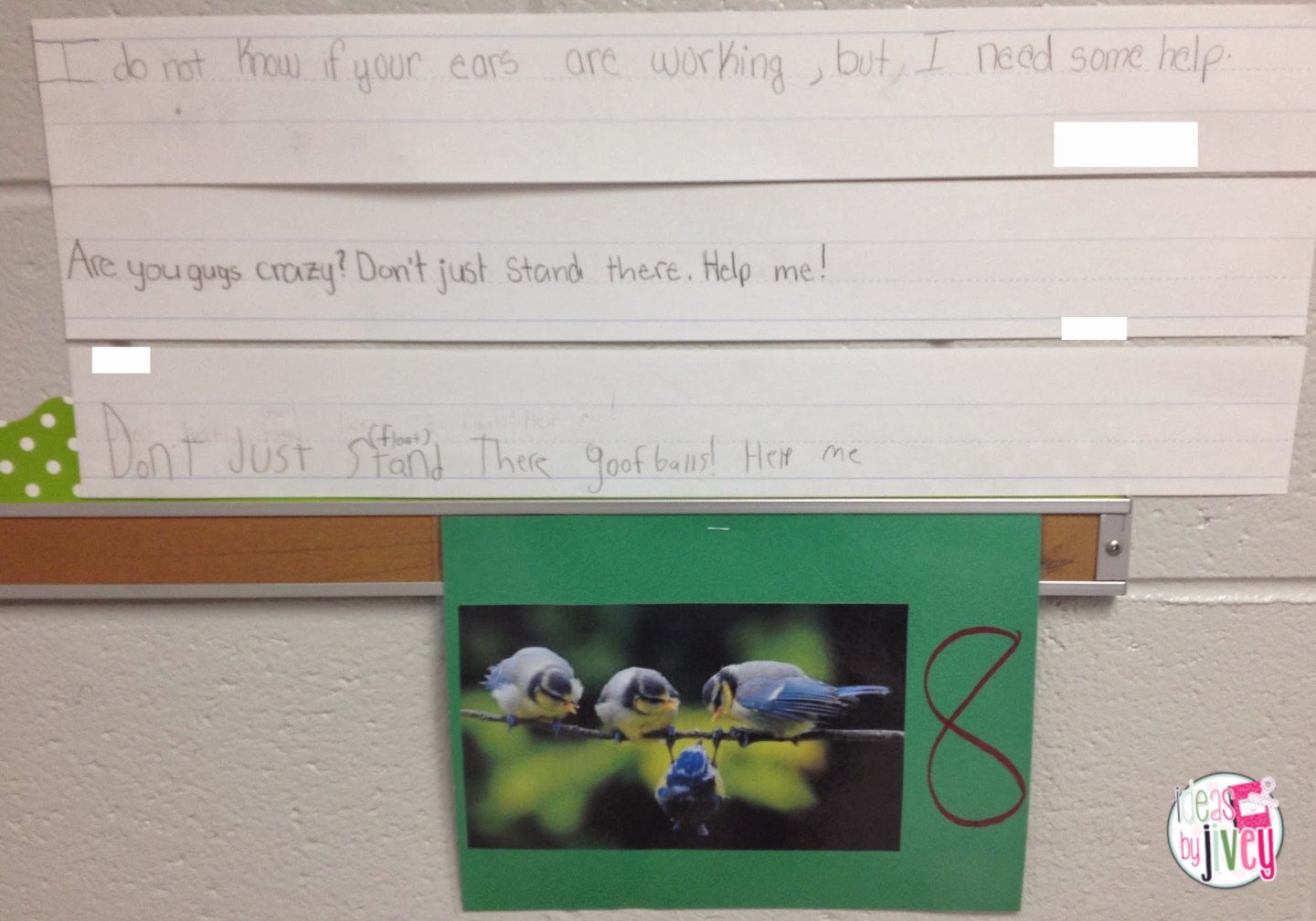
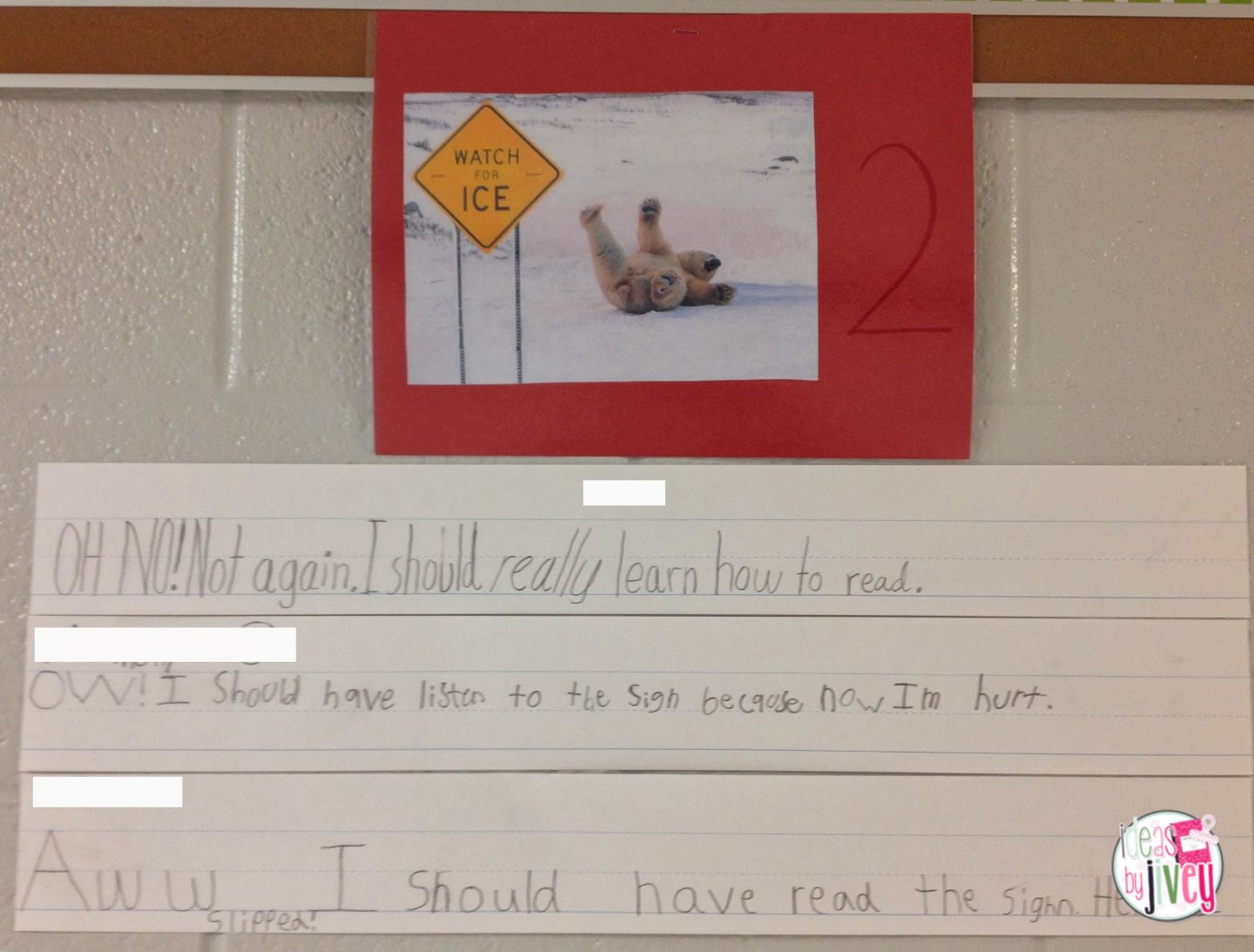
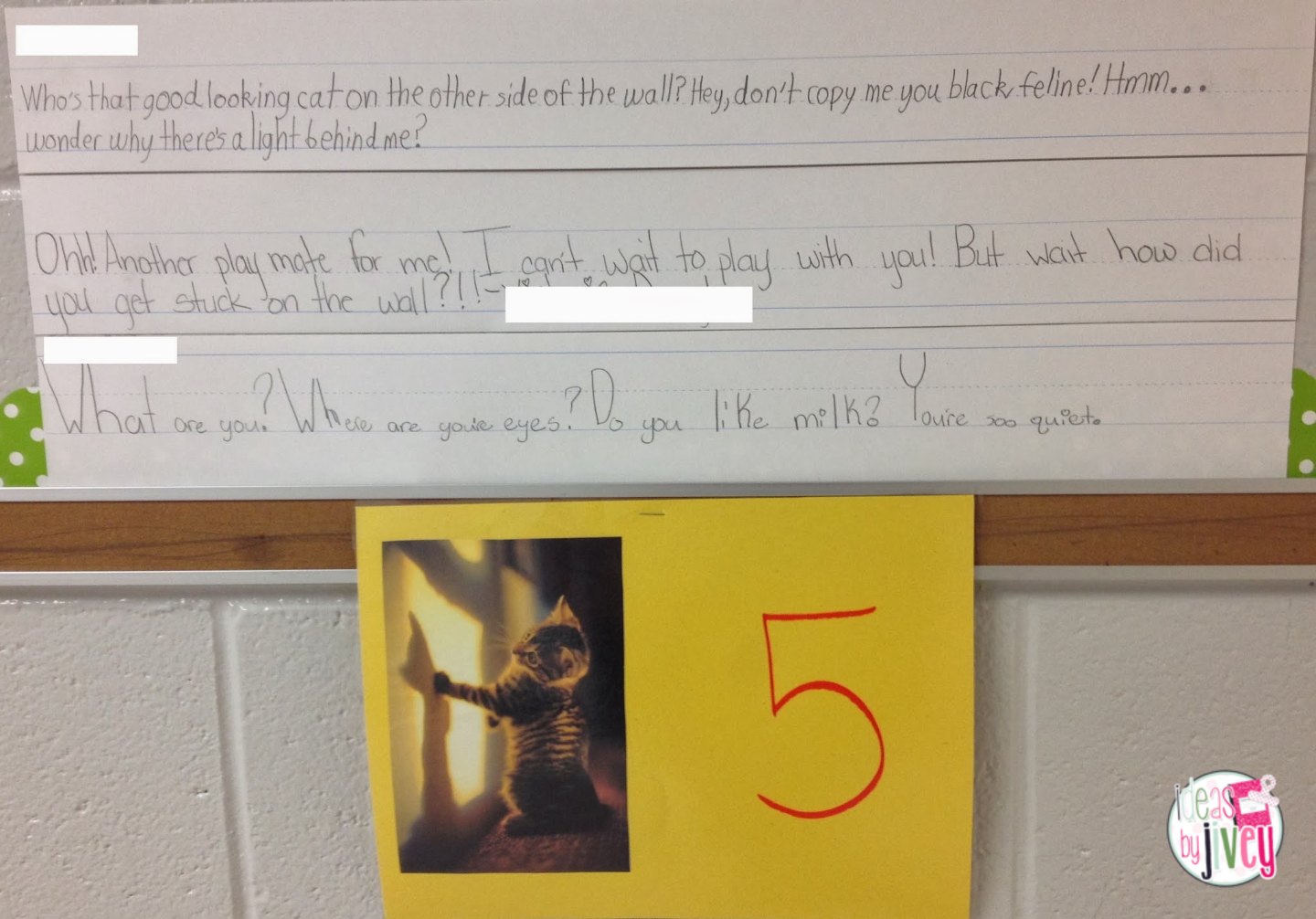
Our caption display in the hall
A few of my favorites:
What happened nextMy students asked if we could do it every week!
Captions get students talking for a character. The next step is writing dialogue: getting that talking onto the page, with the quotation marks and dialogue tags in the right places. I built that progression into my Paper Kingdom unit for grades 3-5. Over the week, students see several images and a short film, all without any words or text, and each lesson asks them to infer a little more.

My Paper Kingdom activities for grades 3-5 give you a week of lessons on making inferences, interpreting visuals, writing dialogue, and irregular verbs. All three lessons below are in it.
See the Paper Kingdom unitStudents imagine what the dog in each of six pictures would say if it could talk. That means paying attention to the details in the photo and to the dog’s body language and expression. There are two ways to set it up:
Then every student writes all six lines as dialogue with the tag “the dog said,” using the dialogue notes page from the day before as a model for punctuation. For a puppy lying in a pile of shredded homework, that might be:
“Don’t worry, I’m sure your teacher will believe you,” the dog said.
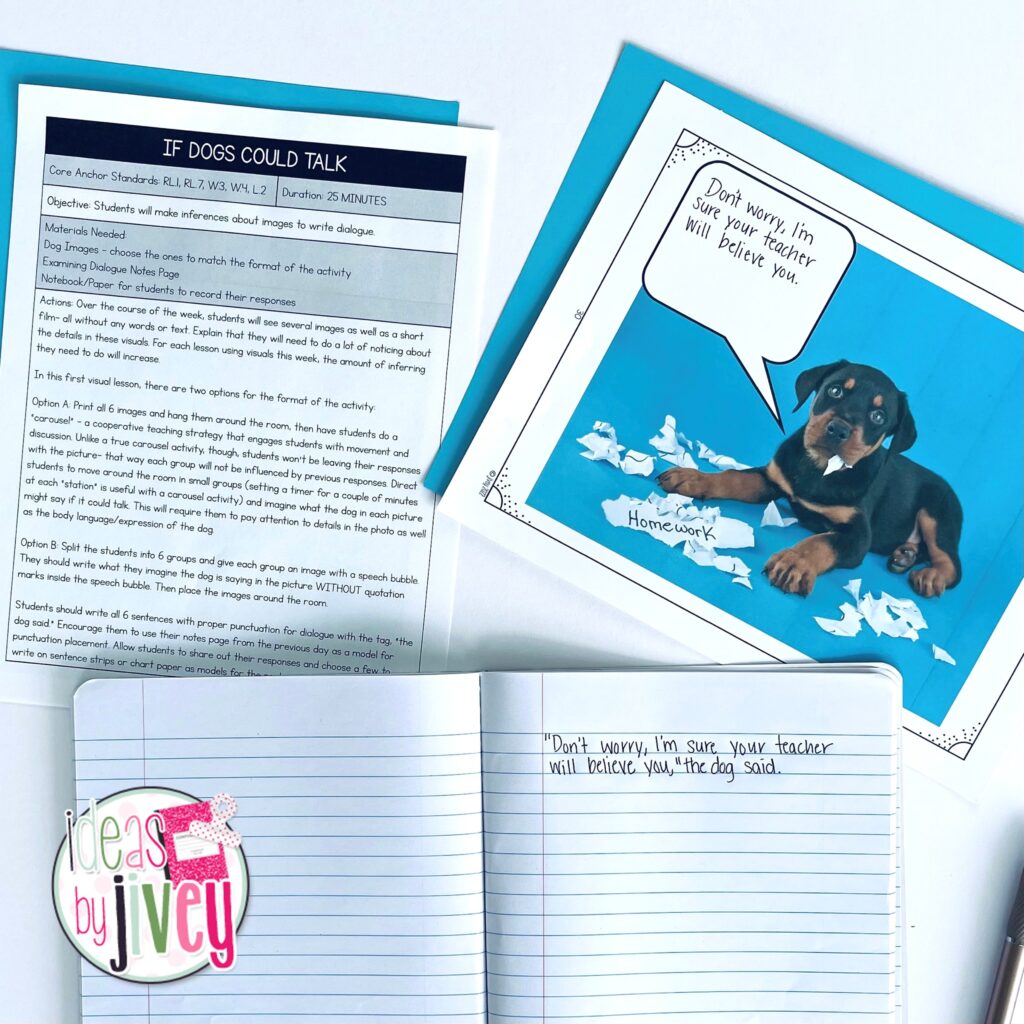
Students share out, and a few go on sentence strips or chart paper as models for the next lesson on writing dialogue.
Dogs and descriptionDog pictures work for descriptive writing, too. See how my Wintercake unit uses them in my show don’t tell post.
Before writing about other photos, students practice inferring. Start with the page in The Paper Kingdom where the family is driving to the office building. Students already inferred that the old, sputtering car might need repairs the family can’t afford. Now they look closely at the illustration: Papa has a furrowed brow and a frown, and Mama looks at Papa as though she’s concerned. Does that support the inference? Yes, they seem worried.
Then model one of the photographs with the guided inference organizer, and let students infer what’s happening in the others. They can work with a partner, look at projected photos, or rotate to photos hung around the room. When they share, remind them there isn’t a right or wrong answer as long as they can support their thinking with their schema, or background knowledge.
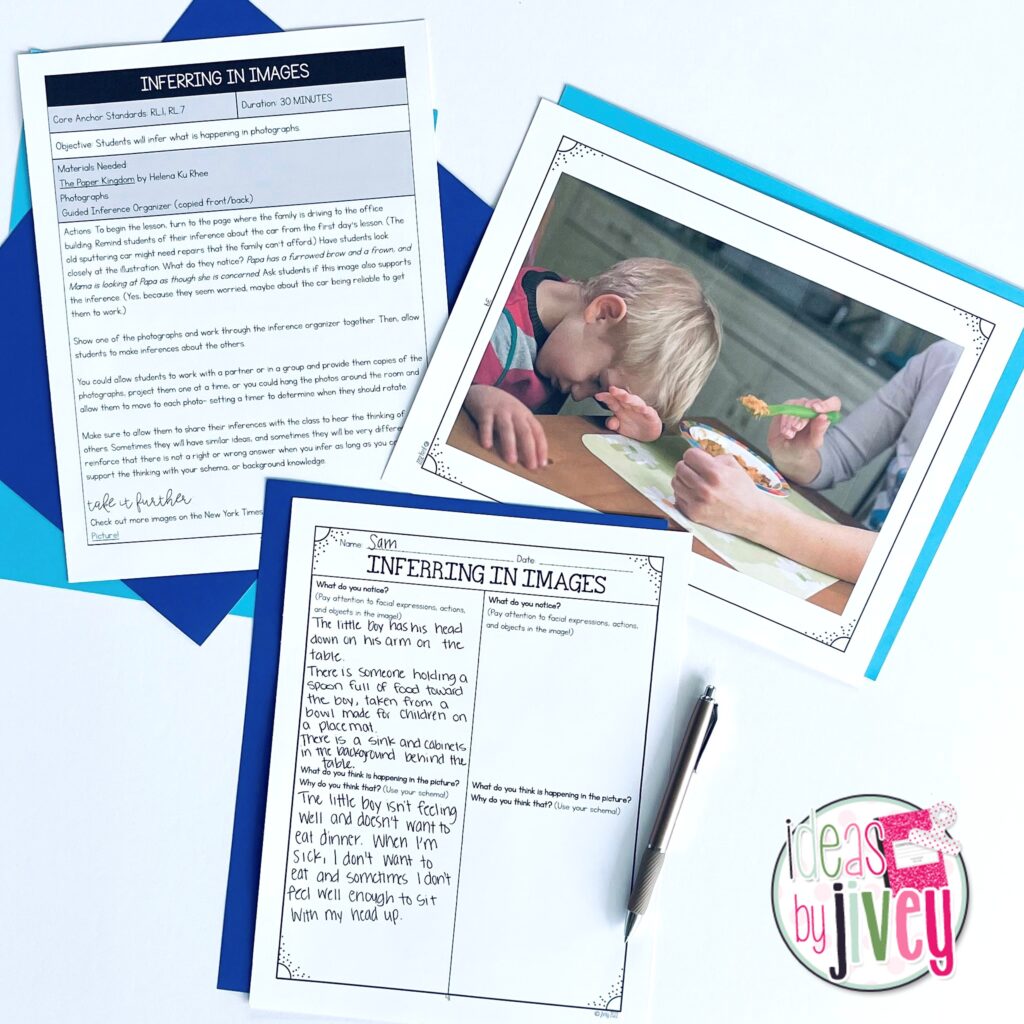
Go back to the photo you modeled and the inference you made together. Now students imagine the people in the picture are talking and start writing dialogue for them, at least one sentence, using quotation marks correctly. The dialogue notes page and the No More Said! verb list help with formatting and word variety.
Give them namesEncourage students to make up names for their dialogue tags instead of writing “the boy” or “the lady.”
Students write dialogue for the other three photos with a partner or on their own, then share out.
This post contains affiliate links to books on Amazon. As an Amazon Associate, I earn from qualifying purchases, at no extra cost to you.
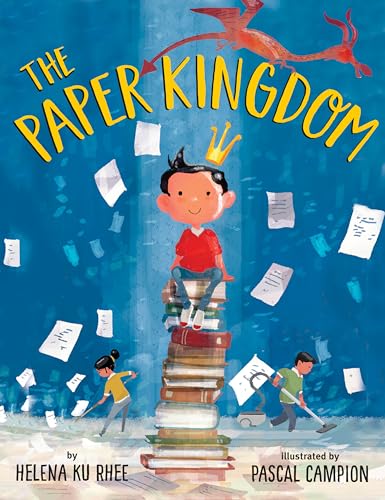
The Paper Kingdom by Helena Ku Rhee, illustrated by Pascal Campion
Get the book on AmazonMy Paper Kingdom unit includes all three lessons, with the photographs, organizers, and dialogue pages. It’s also part of Mentor Text Club, 2nd Edition.
For more practice with dialogue punctuation, my Grammar in Context dialogue lessons come in a 2nd-3rd grade set and a 4th-5th grade set.


