
$20.50 Original price was: $20.50.$16.40Current price is: $16.40.
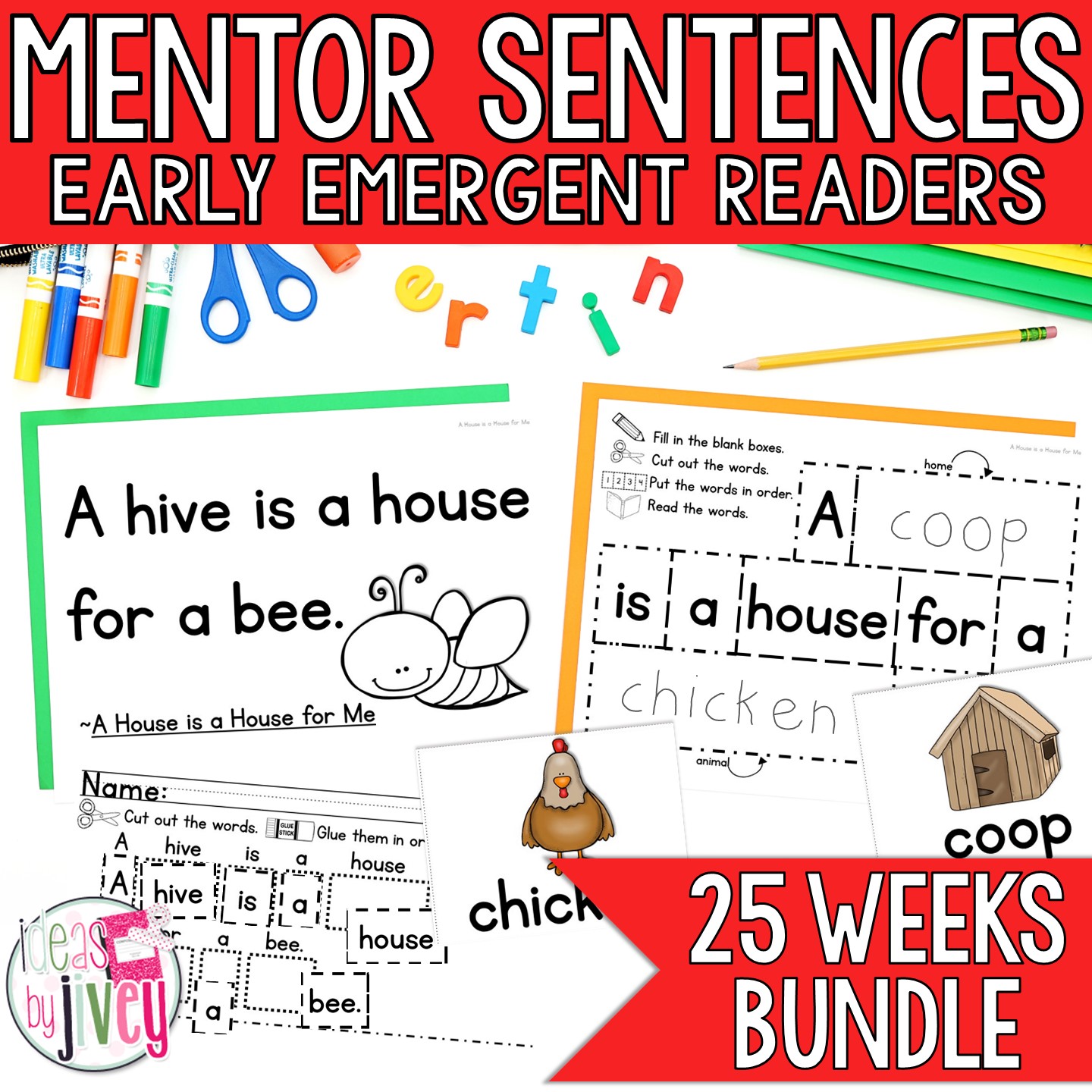
These mentor sentences support early sentence writing for Pre-K, Kindergarten, and even ELL students. I built the set around build-a-sentence activities, using a model sentence pulled from a favorite read-aloud book each week, so students are learning how sentences work from real literature instead of an isolated grammar drill.
These sentence-building lessons are perfect for integrating reading and writing.
Students will:
✔listen to you read the mentor text,
✔identify/notice letters, words, and parts of a sentence,
✔read the words of the mentor sentence,
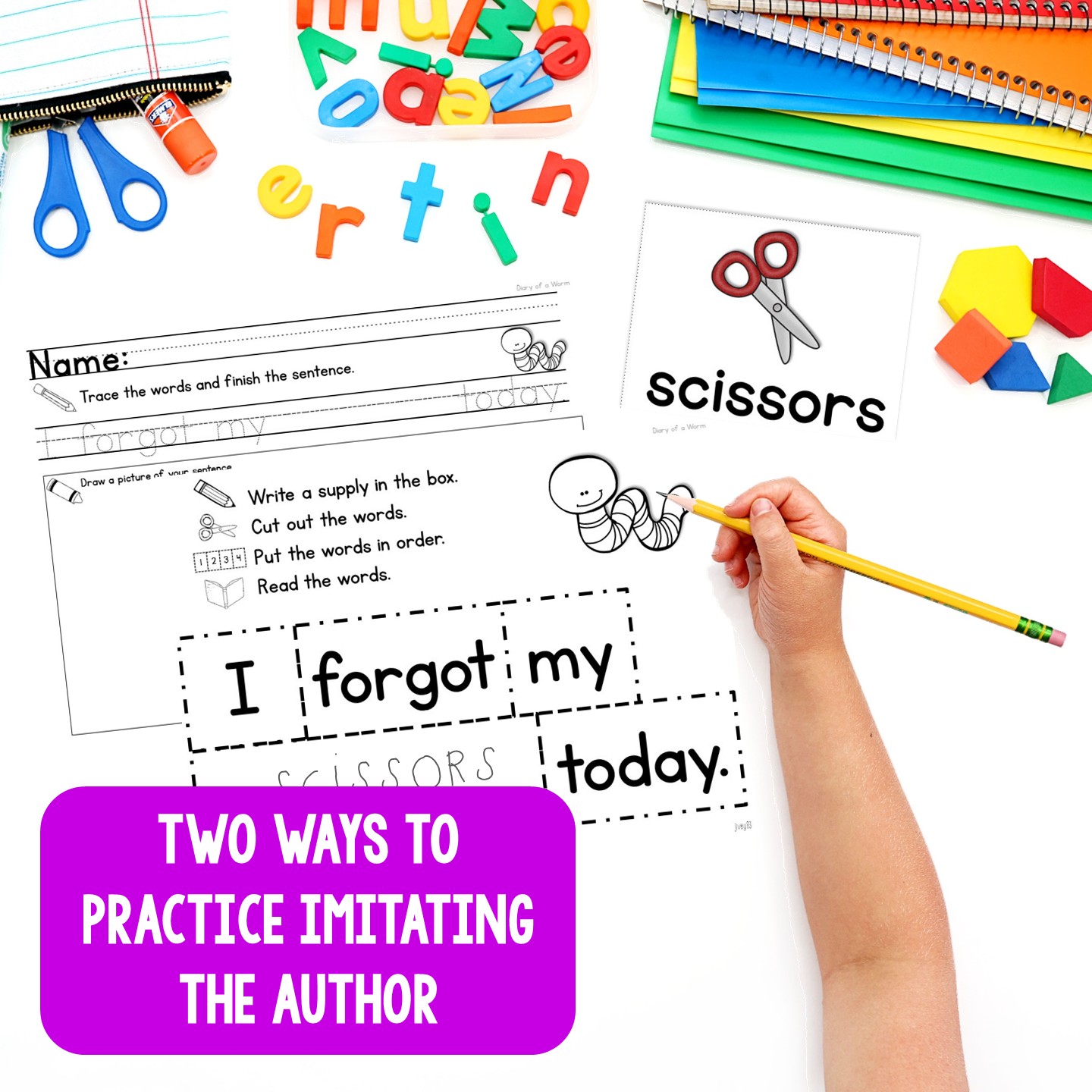
✔arrange the words to re-form the sentence,
✔learn other words that could fit into the sentence,
✔imitate the sentence by writing in their own words,
✔read their sentence,
✔illustrate their sentence,
✔and even create a class book that can be read over and over again.
Your students WILL BE reading AND writing every week!
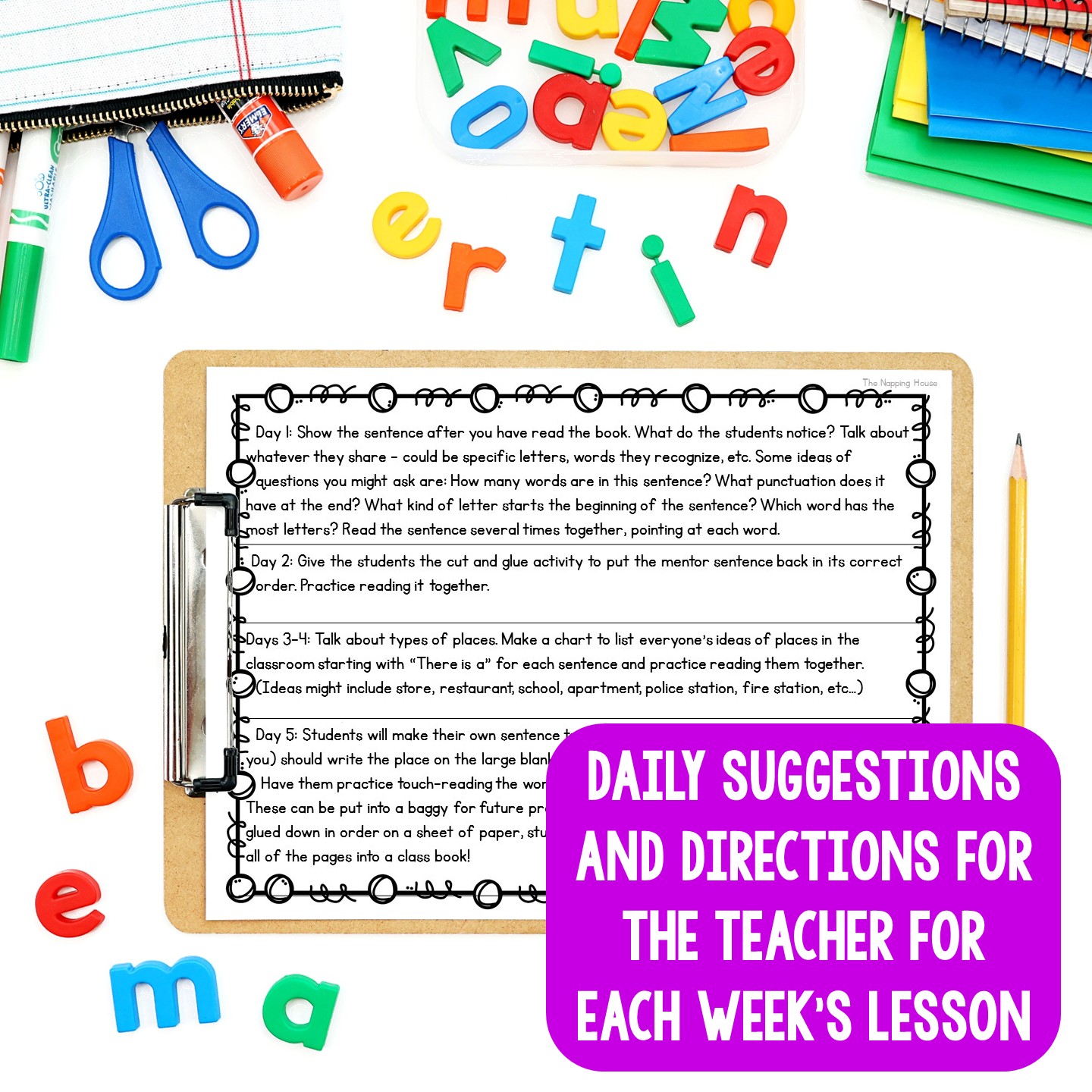
I walk you through each day’s lesson for 25 weeks- all the work is done!
Each lesson includes:
☆ the teacher sentence page,
☆ directions/guidance for each day for the teacher,
☆ the student sentence page with words out of order (students cut and glue them back in order),
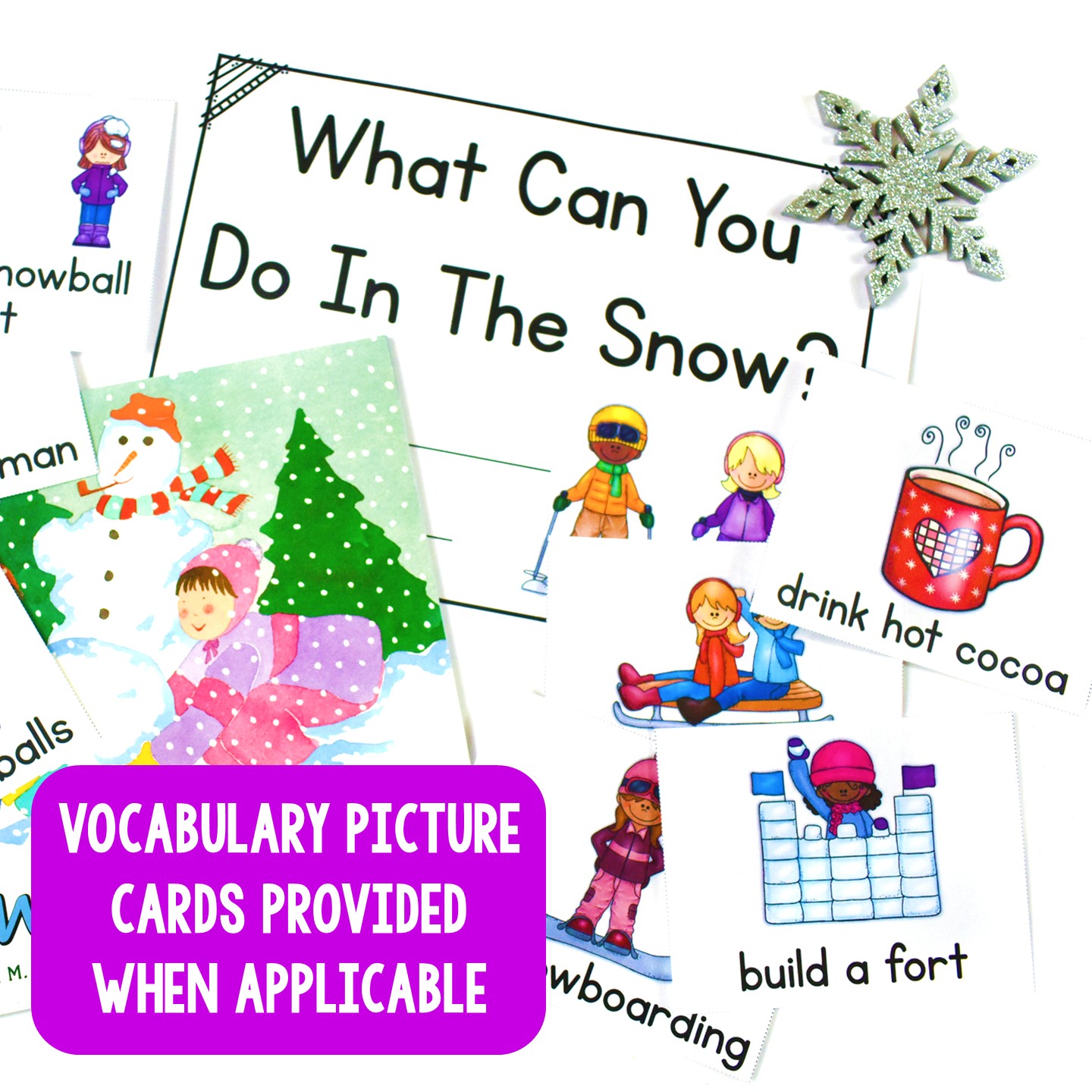
☆ vocabulary picture clue word cards (when applicable) in color and black and white,
☆ the student imitation page,
☆ and a class book cover in color and black and white.
Every week is built around one mentor text chosen because it’s likely already in your classroom, school, or public library:
Chrysanthemum by Kevin Henkes
(name)
Today I Feel Silly by Jamie Lee Curtis
(emotions/feelings)
The Pigeon Finds a Hot Dog! by Mo Willems
(food)
The Napping House by Audrey Wood
(places)
Don’t Let the Pigeon Drive the Bus! by Mo Willems
(vehicles)
Diary of a Worm by Doreen Cronin
(school supplies)
A House is a House for Me by Mary Ann Hoberman
(animal homes)
Brown Bear, Brown Bear, What Do You See? by Bill Martin, Jr.
(colors)
Mary Wore Her Red Dress by Merle Peek
(clothes)
The Very Hungry Caterpillar by Eric Carle
(fruit)
The Dot by Peter H. Reynolds (Dot Day is September 15!)
(what we’re good at/talents)
Five Little Bats Flying in the Night by Steve Metzger
(things that fly)
Clifford’s Halloween by Norman Bridwell
(costumes)
Thanks for Thanksgiving by Julie Markes
(we’re thankful for…)
There Was an Old Lady Who Swallowed a Bell by Lucille Colandro
(holiday items)
There Was a Cold Lady Who Swallowed Some Snow! by Lucille Colandro
(snowman items)
The Missing Mitten Mystery by Steven Kellogg
(things that come in pairs)
The Snowy Day by Ezra Jack Keats
(adjectives)
Snow Is Falling by Franklyn M. Branley
(things to do when it snows)
The Hat by Jan Brett
(winter clothing items) *also contains dialogue
The Reason for a Flower by Ruth Heller
(animals that drink nectar)
Waiting for Wings by Lois Ehlert
(butterfly life cycle)
There Was an Old Lady Who Swallowed a Chick! by Lucille Colandro
(Easter)
Hurray for Spring! by Patricia Hubbell
(things to do in spring)
The Caterpillar and the Polliwog by Jack Kent
(animal babies) *with dialogue
You don’t need to teach these in the order they’re listed. I sequenced them to progress in difficulty, so the lessons spiral, but it’s not necessary to stay in that order. The winter and spring sets are a bit more rigorous, since they’re meant for later in the year.
Should my kindergartener be able to write a sentence?
By the end of kindergarten, most students can write a simple sentence with support, though it develops gradually across the year. This set builds that skill in steps: students notice a model sentence from a read-aloud book, rebuild it by arranging its words back in order, then imitate it in their own words, so writing a full sentence never feels like it’s coming out of nowhere.
What is a build-a-sentence activity?
A build-a-sentence activity has students physically construct or reconstruct a sentence, rather than filling in a blank or copying one. In this set, students cut apart the words of a mentor sentence and glue them back in order, then use that same sentence as a model to write one of their own.
Is this for Pre-K, or just Kindergarten?
I built this set with Pre-K, Kindergarten, and early emergent readers in mind, including ELL students who are just starting to connect spoken and written language. If your students aren’t cutting and gluing independently yet, lean more on the read-aloud and discussion portion of each lesson.
How is this different from your Emergent Mentor Sentences bundle?
This Early Emergent set is built for Pre-K and Kindergarten students who are just starting to read and write. My Emergent Mentor Sentences bundle (grades K-1, 40 weeks) moves a step further, with students noticing grammar more independently and writing longer imitations. Not sure which one fits your class? Here’s how to decide.
Please remember, this purchase is for the use of one teacher. It is not intended to be shared. Please use the ‘additional license’ purchase if more than one teacher will be using it. Thank you!
*The mentor sentence lessons I have created are adapted from the ideas of Jeff Anderson. These lessons were born from the routine that worked well in my classroom, and the demos and examples I present are variations of Jeff Anderson’s methods. This is not the only way to “do” mentor sentences in your classroom.*
Copyright © Ideas By Jivey, LLC
All rights reserved by author, Jessica Ivey.
Permission to copy for single classroom use only.
Electronic distribution limited to single classroom use only.
Not for public display.
Thank you. Your review was received and will appear once it has been checked.
Please log in to the account you used to buy this resource. Only customers who bought it from this shop can leave a review.
just what I need
Just what I needed for my kindergarten morning meetings
Perfect for Young Learners!
Some of my ELLs are really low and have low exposure to literacy. Using mentor sentences that are at their level has helped encourage them to try and practice reading some words.
I use this resource with my ELL small groups. It has been a big hit! The vocab cards are a great language scaffold. I've also used it with my older Newcomers. Great product!!
I had used and loved mentor sentences with 2nd grade and was so hoping this would work with my Kindergarten readers. We just love it!! It’s a great way to introduce quality text, focus on important concepts, practice reading and writing, and the class book project is a bonus!!


