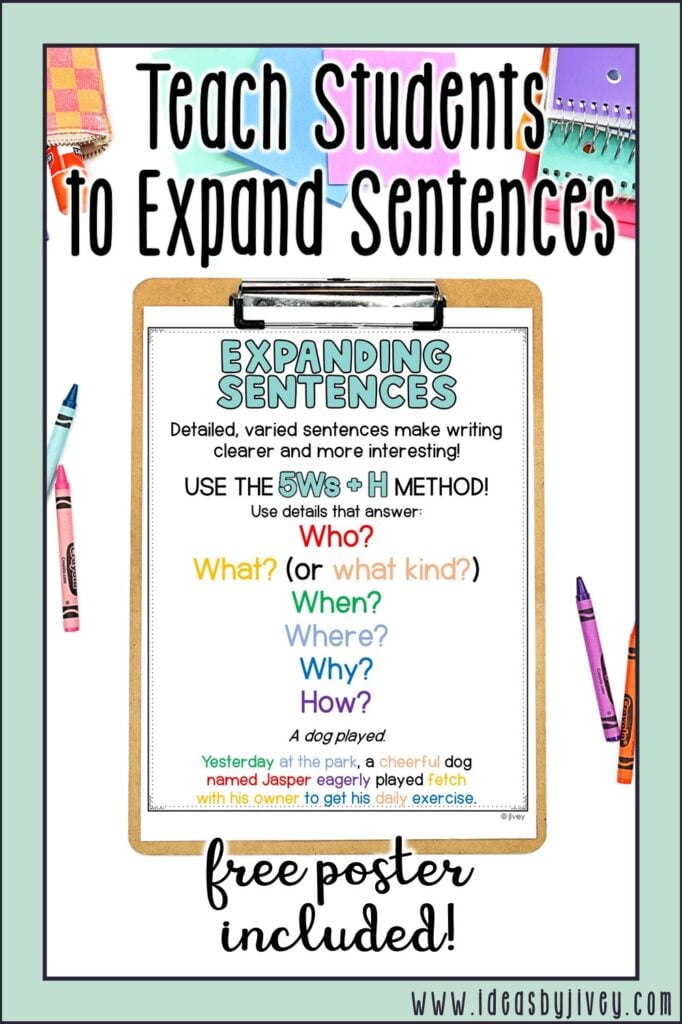
Expanding sentences is one of the quickest ways to move student writing from a simple, “A student planted,” to a sentence a reader can actually picture. The trick is giving students something more concrete than “add more details.” Below is the 5 Ws + H method I share in my Write On! grammar lessons, a simple way to teach it, examples you can model with right away, and a free expanding sentences poster for your writing center.
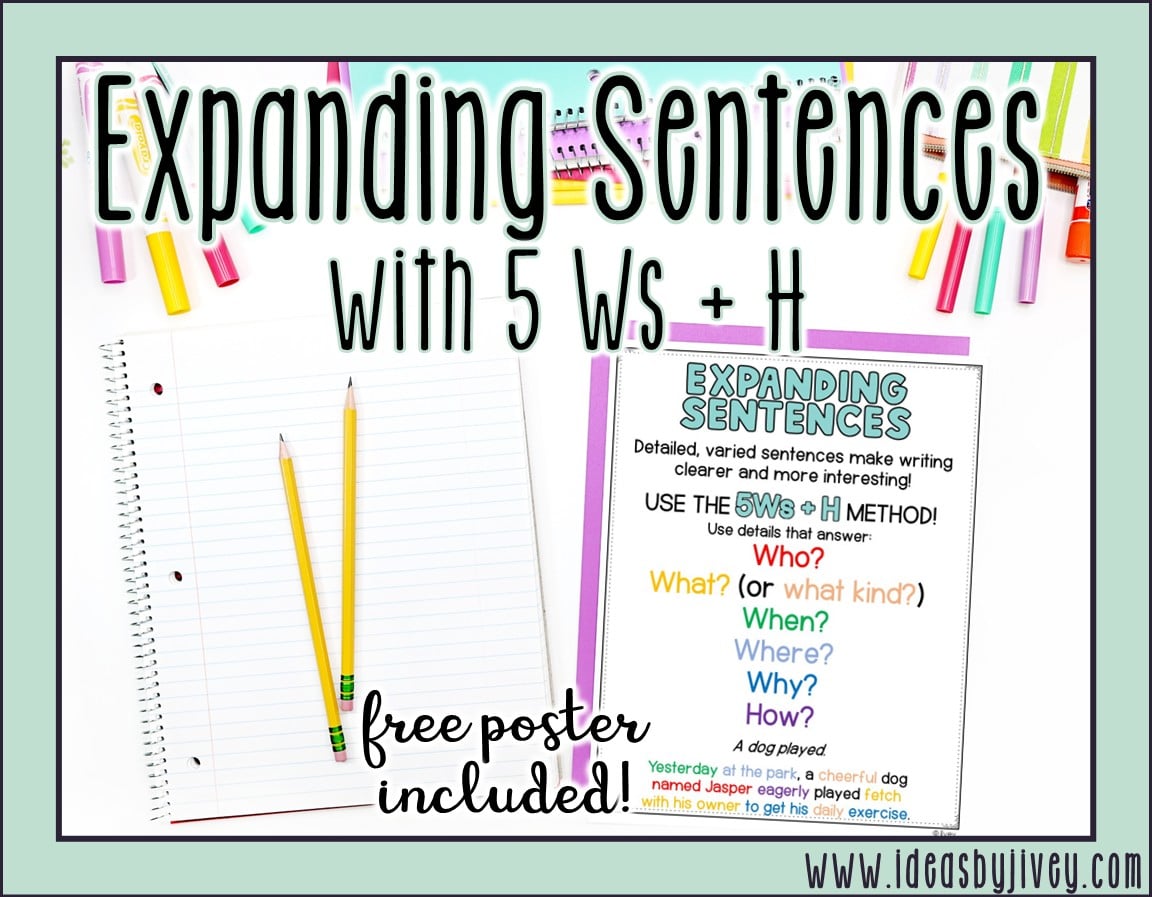
Expanding a sentence means taking a short, plain sentence and adding details that help the reader see exactly what’s happening. The core of the sentence stays the same. The new details answer questions a reader might ask.
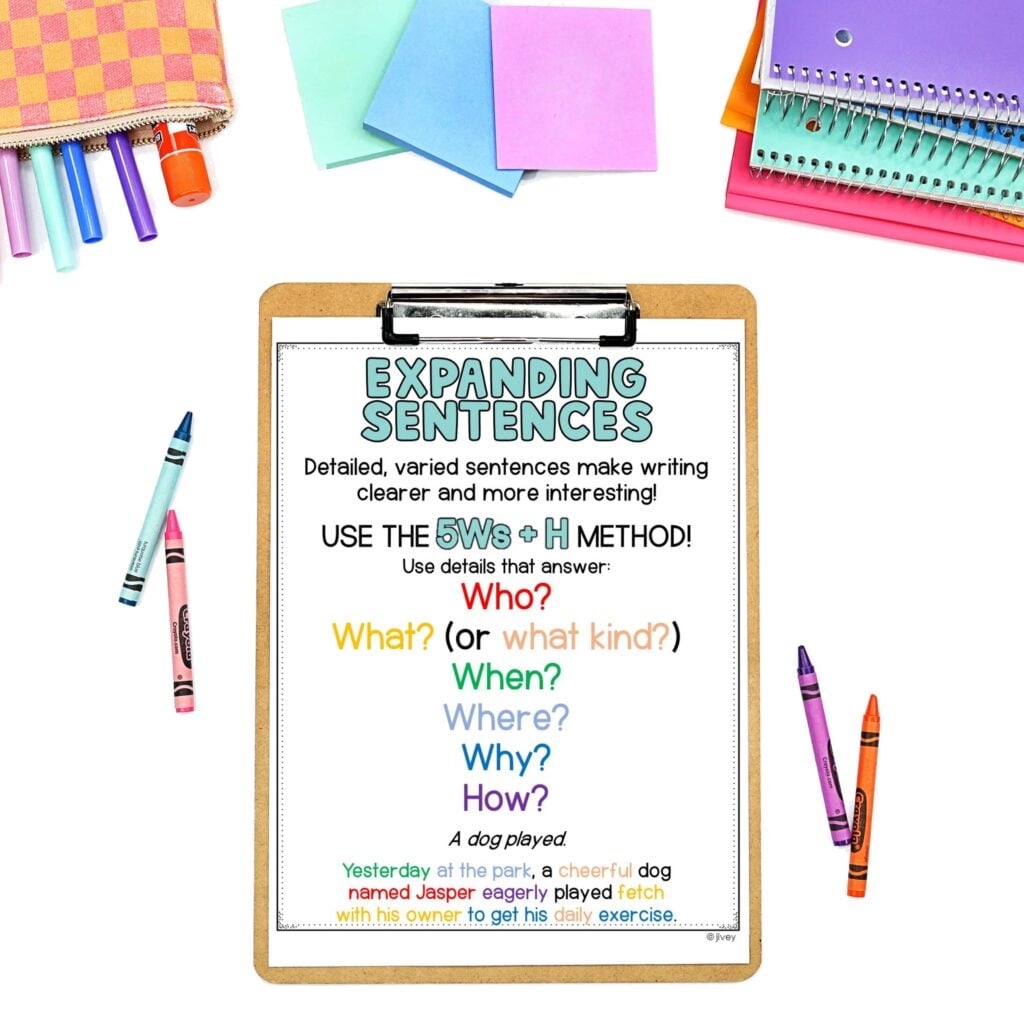
A dog played.
Yesterday at the park, a cheerful dog named Jasper eagerly played fetch with his owner to get his daily exercise.
You’re talking about the same dog and the same action. The second sentence just answers more of the reader’s questions.
Here’s a hint“Add more details” doesn’t tell students which details to add. Questions do.
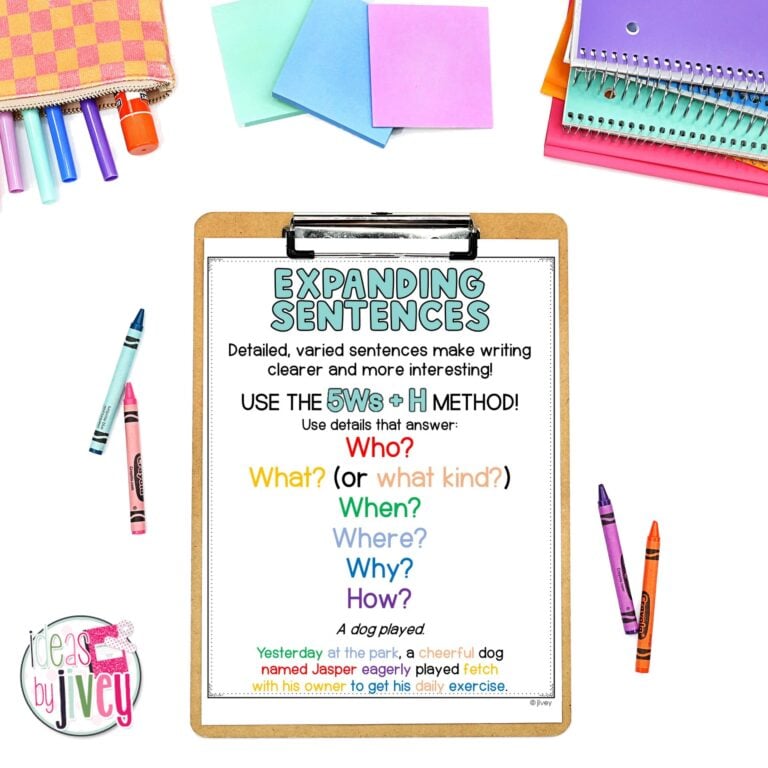
The 5 Ws + H give students a short list of questions to ask about any sentence. Here’s how each one shows up in the Jasper sentence:
On the poster, each detail in the Jasper sentence is the same color as the question it answers, so students can see where every piece came from.
Keep it simpleStudents don’t need to answer all six questions in every sentence. One or two well-chosen details usually do more than six crammed together.
Expanding sentences is a writing revision strategy, but it’s also grammar in disguise! Every question in the 5 Ws + H is answered with a specific part of speech. When students add a detail, they’re choosing a noun, an adjective, an adverb, or a phrase on purpose:
So each time students expand a sentence, they practice the parts of speech by using them, not just by naming them. It also lines up with the grammar standards most elementary grades share, which ask students to expand and rearrange sentences, explain what nouns, pronouns, verbs, adjectives, and adverbs do in a sentence, and form and use prepositional phrases.
Why it sticksStudents remember a part of speech when they use it to fix their own sentence.
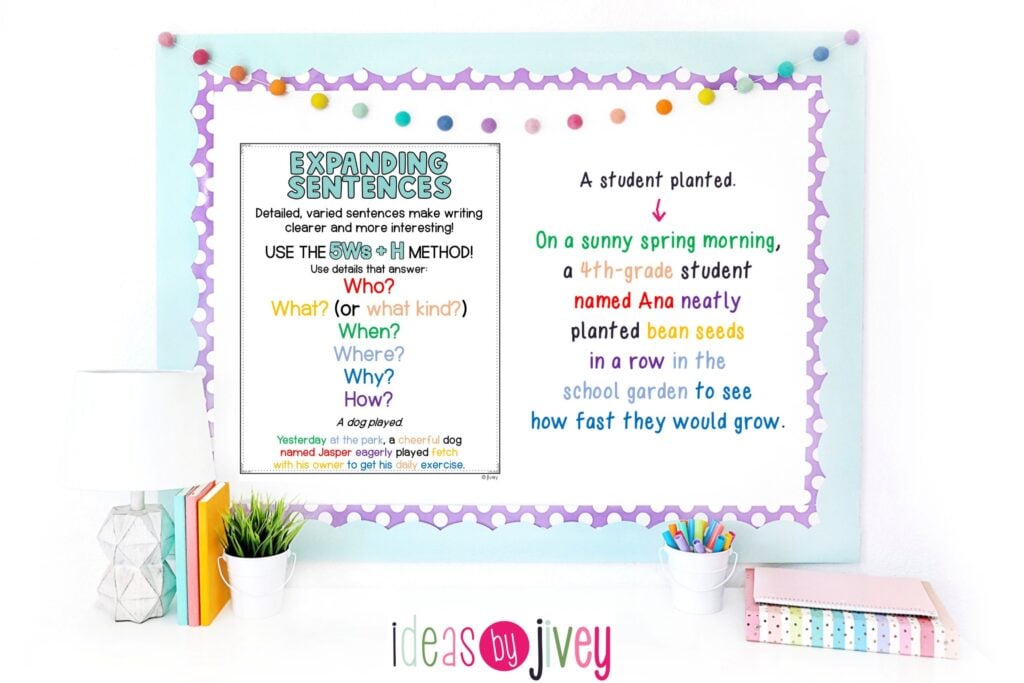
Write a short sentence on the board, like “A student planted.” Ask students what they can picture. Usually the answer is: not much!
Go through the 5 Ws + H one at a time and jot students’ answers next to each question. Every answer is a detail they could add.
Choose two or three answers and add them to the sentence. Read each new version aloud and talk about what the reader can see now that they couldn’t before.
Watch the sentence grow
A student planted.
A 4th-grade student named Ana planted.
On a sunny spring morning, a 4th-grade student named Ana planted in the school garden.
On a sunny spring morning, a 4th-grade student named Ana neatly planted bean seeds in a row in the school garden.
On a sunny spring morning, a 4th-grade student named Ana neatly planted bean seeds in a row in the school garden to see how fast they would grow.
Have students find one plain sentence in a draft they’re working on and expand it with at least two of the questions. This is where expanding sentences moves from practice into students’ real writing.
Make it a game: Write a plain sentence on the board and go around the room. Each student adds only one detail, and it has to make sense with everything that’s been added before it. If a detail doesn’t fit, the class helps fix it. When the sentence gets long, ask students which three details they’d keep if they could only choose three.
Here are a few plain sentences to model with, and one way to expand each. Your students’ versions will (and should!) look different.
A bat swooped.
Late last night, a hungry brown bat swooped silently over the pond to catch a mosquito.
A boy shouted.
At recess, a boy named Marcus shouted across the playground because his team had just scored.
The bell rang.
At exactly 3:00, the old school bell rang loudly down the hallway to end the day.
Free poster
Print it as an anchor chart, hang it in your writing center, or have students glue it in their notebooks. It shows all six questions with a color-coded example sentence. Enter your email and I’ll send it to your inbox!
If you want the full lessons, my Expanding Sentences units teach students to expand sentences with the 5 Ws + H and to combine sentences that repeat. Each one has an original story and an original nonfiction passage to explore, plus application activities on the same theme, in print and Google Slides.
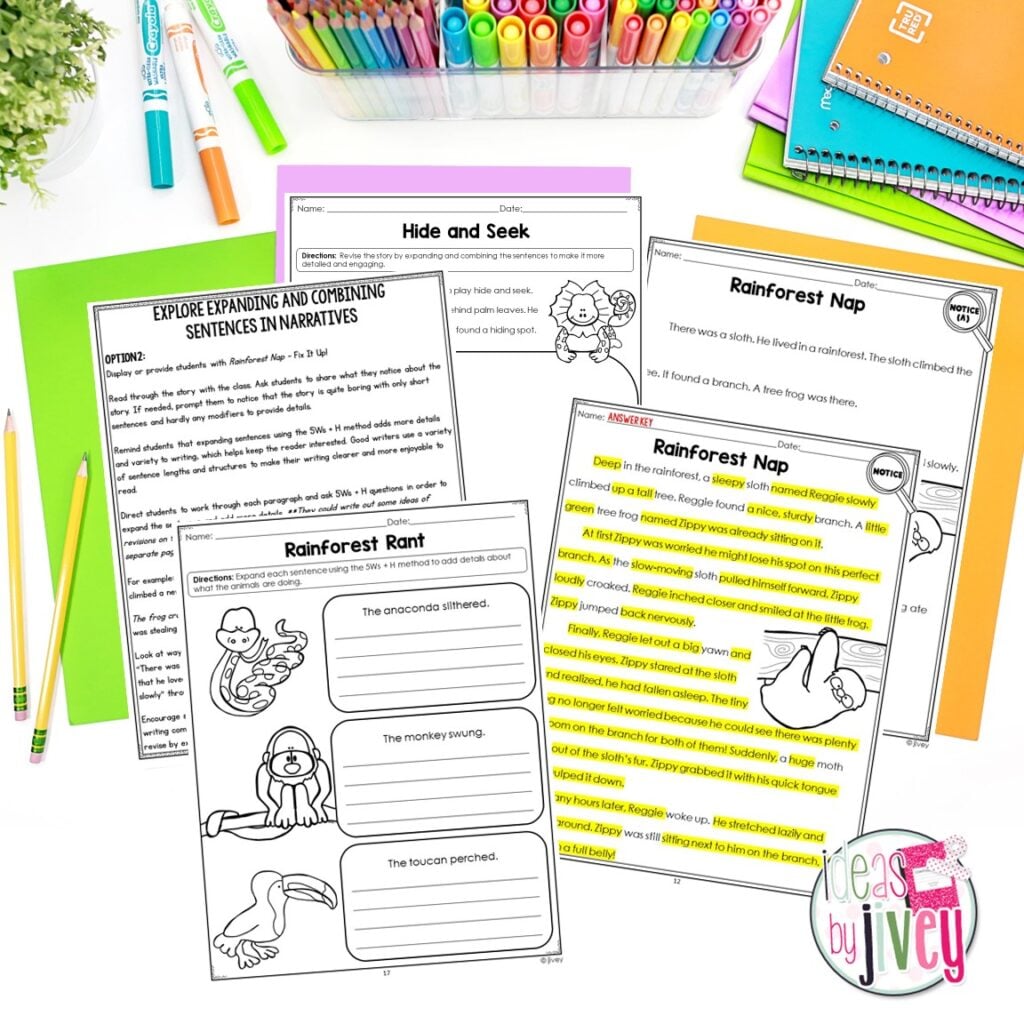
Expanding Sentences for 2nd and 3rd grade uses a story about a sloth and a tree frog and a passage about animals of the rainforest canopy. Expanding Sentences for 4th and 5th grade uses a story about a pancake-making machine and a passage about Rube Goldberg.
Expanding Sentences is also part of the Write On! Super Bundle, with all 14 grammar skills and all 8 revision strategies for your grade band.
Through November 30The Super Bundle is $39, the same price as the Grammar in Context bundle on its own.