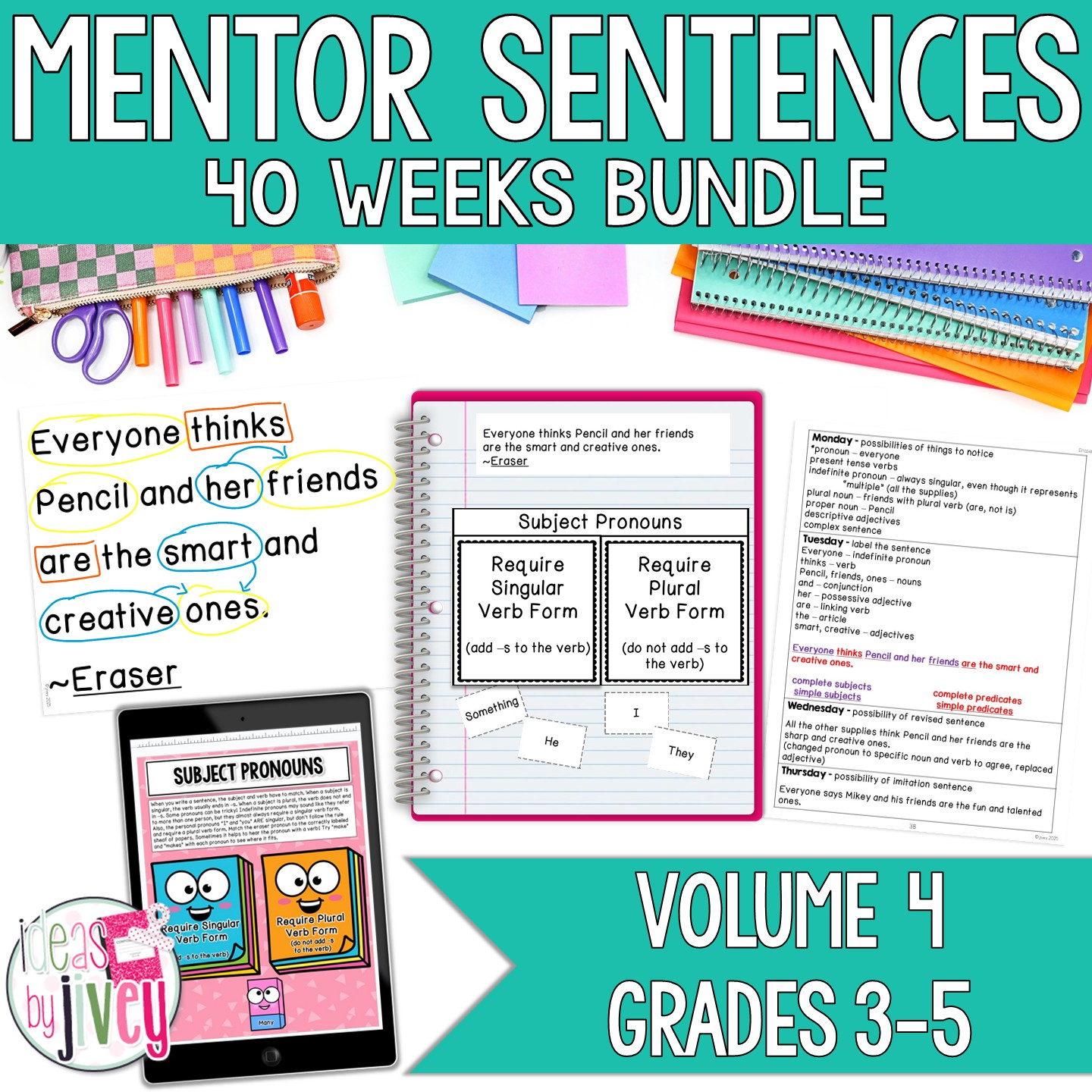
These mentor sentences give you 40 weeks of grammar lessons for 3rd, 4th, and 5th grade: all four Volume 4 units in one bundle, built on one sentence from a picture book each week. The 40 books come in 20 pairs, so the books students read together connect from one week to the next.
Each day, students spend 10 to 15 minutes with the same sentence, working with it in a new way: noticing, labeling, revising, and writing their own. You don’t need to be a grammar expert to teach it. I’ve already done the thinking for every day, right down to sample revisions and imitations, so you can open the lesson plan and go!
The books are not included. I chose favorite read-alouds that most school libraries already have.
How the mentor sentence routine works:
1
Notice: students read the sentence and talk about what they notice. Your lesson plan lists what to look for.
2
Label: students label the parts of the sentence, with the week’s focus skill front and center.
3
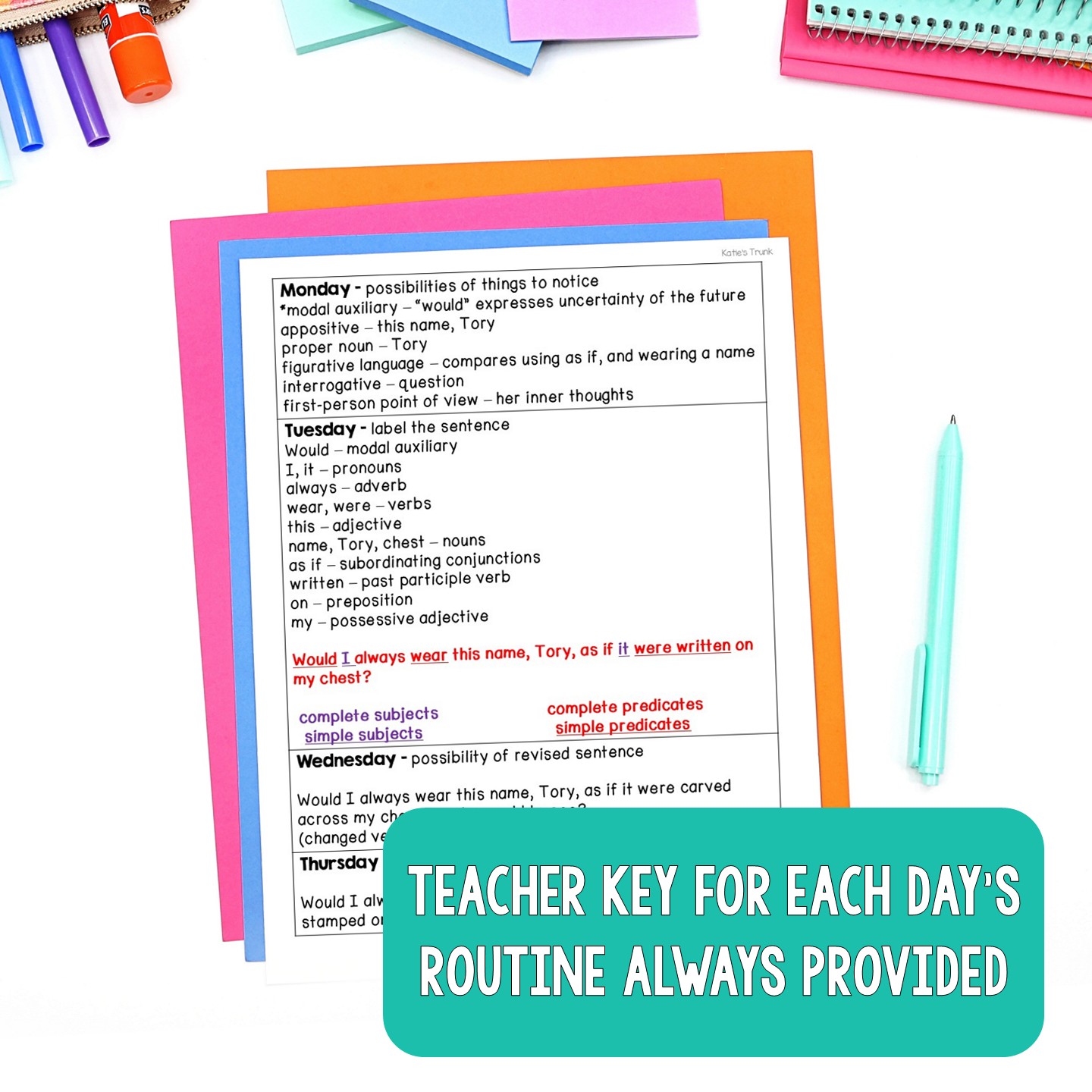
Revise: students revise the sentence, and the lesson plan gives you a sample revision.
4
Imitate: students write their own sentence in the author’s style and structure, with a sample in the lesson plan.
5
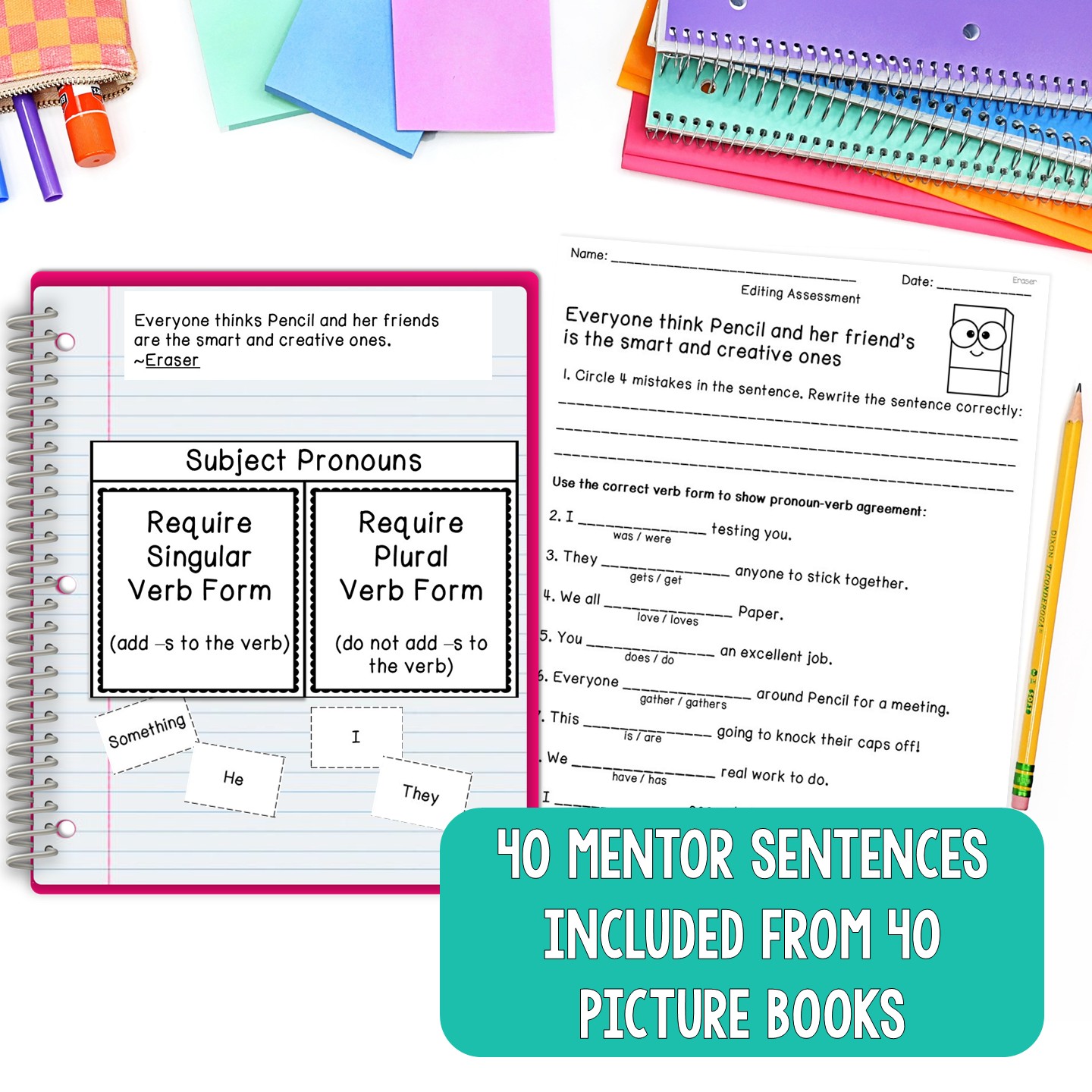
Assessment: a short quiz with editing practice shows you which skills to bring back.
Start here if mentor sentences are new to you. Unit 1 opens with a 9-page introduction to the routine, with photos and day-by-day directions.
What’s included:
A 9-page introduction to the routine with photos and day-by-day directions, at the start of Unit 1
4 units with 40 mentor sentence lessons, one for each book, and each one includes:
A teacher sentence page to display
A student sentence page to glue into notebooks
A lesson plan page with answers for each day of the routine
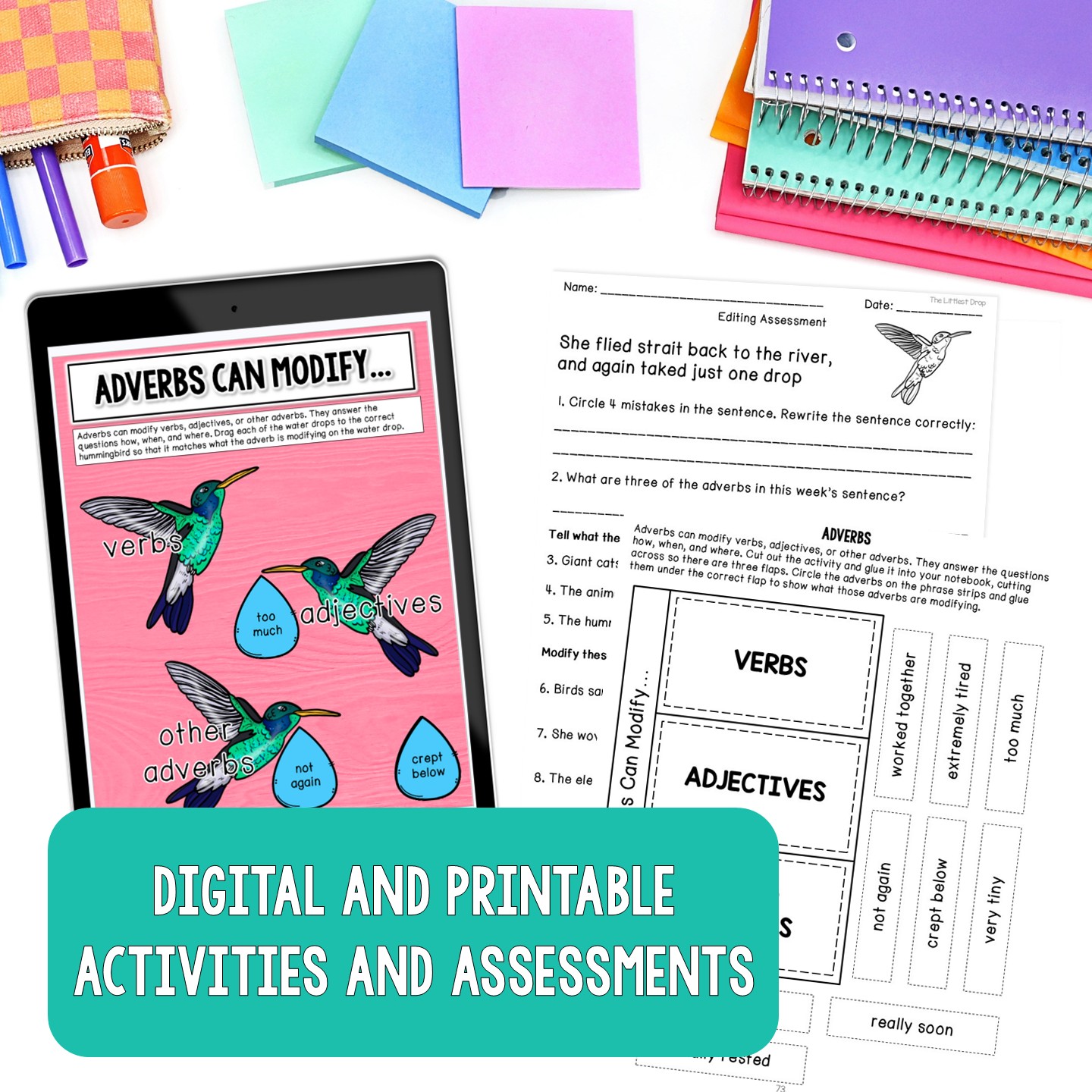
A quiz with editing practice and an answer key, in print and digital
An interactive notebook activity for the focus skill, in print and digital
The Volume 4 At-A-Glance: Mentor Sentences, Reading, and Vocabulary Skills Planning Map
Books used in this bundle:
Unit 1 (best at the beginning of the school year)
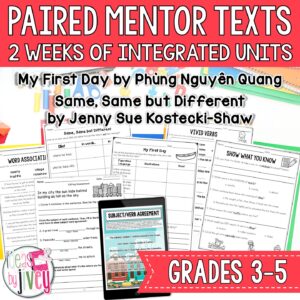
My First Day by Phùng Nguyên Quang: subjects and predicates
Same, Same but Different by Jenny Sue Kostecki-Shaw: subject-verb agreement
The Jade Bracelet by Hà Dinh: vivid verbs
Your Name Is a Song by Jamilah Thompkins-Bigelow: quotation marks
Digging for Words: José Alberto Gutiérrez and the Library He Built by Angela Burke Kunkel: metaphors
Planting Stories: The Life of Librarian and Storyteller Pura Belpré by Anika Aldamuy Denise: personification
Leif and the Fall by Adam Grant and Allison Sweet Grant: homonyms
Fall Leaves by Loretta Holland: commas in a series
Stumpkin by Lucy Ruth Cummins: similes
Pumpkin Circle: The Story of a Garden by George Levenson: metaphors
Unit 2
Hurricanes! by Gail Gibbons: combining sentences
Hurricane by John Rocco: compound sentences
The Cool Bean by Jory John and Pete Oswald: adverbs vs. prepositions
The Smart Cookie by Jory John and Pete Oswald: introductory elements
Eraser by Anna Kang: subject pronouns
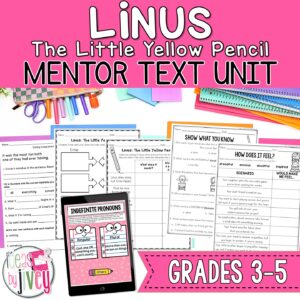
Linus the Little Yellow Pencil by Scott Magoon: indefinite pronouns
Odder: An Otter’s Story (the picture book, not the novel) by Katherine Applegate: irregular verbs
The Spirit of Springer by Amanda Abler: helping verbs: forms of to be
Merry and Hark: A Christmas Story by April Genevieve Tucholke: ordering adjectives
The Urban Owls by Christian Cooper: comparatives and superlatives
Unit 3
Let the Children March by Monica Clark-Robinson: simple vs. compound sentences
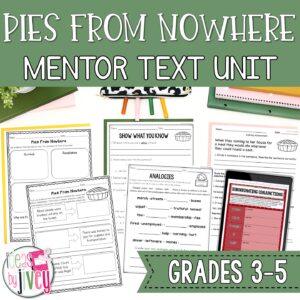
Pies From Nowhere by Dee Romito: subordinating conjunctions
Love, Z by Jessie Sima: introductory phrases
Love by Matt de la Peña: prepositional phrases
Give Bees a Chance by Bethany Barton: independent and dependent clauses
The King of Bees by Lester Laminack: complex sentences
The Tree Lady by H. Joseph Hopkins: relative pronouns
Seeds of Change by Jen Cullerton Johnson: verb consistency or past perfect verb tense (both versions included)
The Littlest Drop by Sascha Alper: adverbs
Follow the Moon Home by Philippe Cousteau and Deborah Hopkinson: subject and object pronouns
Unit 4 (social studies and science books, any time of the year)
A Rock Is Born by Richard Ho: fragments
A Stone Is a Story by Leslie Barnard Booth: vivid verbs
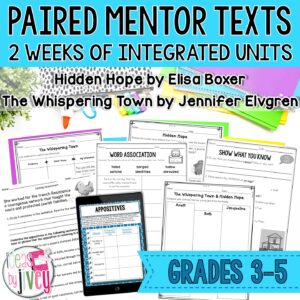
Hidden Hope by Elisa Boxer: appositives
The Whispering Town by Jennifer Elvgren: participial phrases
Katie’s Trunk by Ann Turner: modal verbs
The Scarlet Stockings Spy by Trinka Hakes Noble: figurative language
The Ocean Gardener by Clara Anganuzzi: irregular past tense verbs
Coral Reefs by Gail Gibbons: subject-verb agreement
The Ballad of Cactus Joe by Lily Murray: adjectives
Cactus Hotel by Brenda Guiberson: rephrasing questions
Why use mentor sentences for daily grammar practice?
Fix-the-sentence drills hand students a sentence full of mistakes. If they don’t already know the rule, they can’t spot the errors, and fixing someone else’s mistakes doesn’t show them what a strong sentence looks like. That’s why the practice so rarely shows up in their own writing.
Mentor sentences flip that! Each week starts with a model sentence from a published author, and students soak up the grammar by noticing it, talking about it, and trying it in a sentence of their own. They pick up craft along the way, too: figurative language, descriptive words and phrases, and sentence variety they can borrow for their own writing.
Research backs up teaching grammar in context instead of in isolation. A large review of writing studies for grades 4 to 12 found that grammar taught in isolation did not improve students’ writing (Graham and Perin, 2007).
The routine stays the same every week, so students of any ability know exactly what to expect. Each week focuses on one or two skills, but students also meet new and earlier skills in every sentence, and that spiral review keeps them in front of students all year!
New to mentor sentences? My Mentor Sentences for 3-5 page walks through how they work in upper elementary.
How the units fit together:
Units 1 to 3 get more challenging as they go, and Unit 4 uses social studies and science books so you can add content-based weeks throughout the year. You don’t have to follow the unit order.
Volume 1, Volume 2, and Volume 3 use different books, so teachers in different grades at the same school don’t repeat lessons.
Go further with these books:
Every book in Volume 4 also has its own read-aloud unit with reading activities, a writing prompt, and vocabulary, and the books are sold in pairs, too.
Volume 4 Yearlong Curriculum: the mentor sentences, interactive notebook activities, reading activities, vocabulary, and writing prompts for all 40 books, in 20 paired units.
This purchase is for one teacher. Please don’t share the files with other teachers. Thank you!
Thank you. Your review was received and will appear once it has been checked.
Please log in to the account you used to buy this resource. Only customers who bought it from this shop can leave a review.
★★★★★TpT buyer review
Such a great resource!
Such an amazing resource! I am so excited to add these new books to my rotation of mentor text!
First Grade is Lots of FunGrades taught: Pre-K, K, 1, 2, 3 · August 18, 2026
★★★★★TpT buyer review
Amazing Resource!
Se did it again! Another volume of great books to teach specific grammar lessons! I have all four volumes and they are invaluable in my classroom! I see such an improvement in my students each year!