


$40.00 Original price was: $40.00.$28.00Current price is: $28.00.
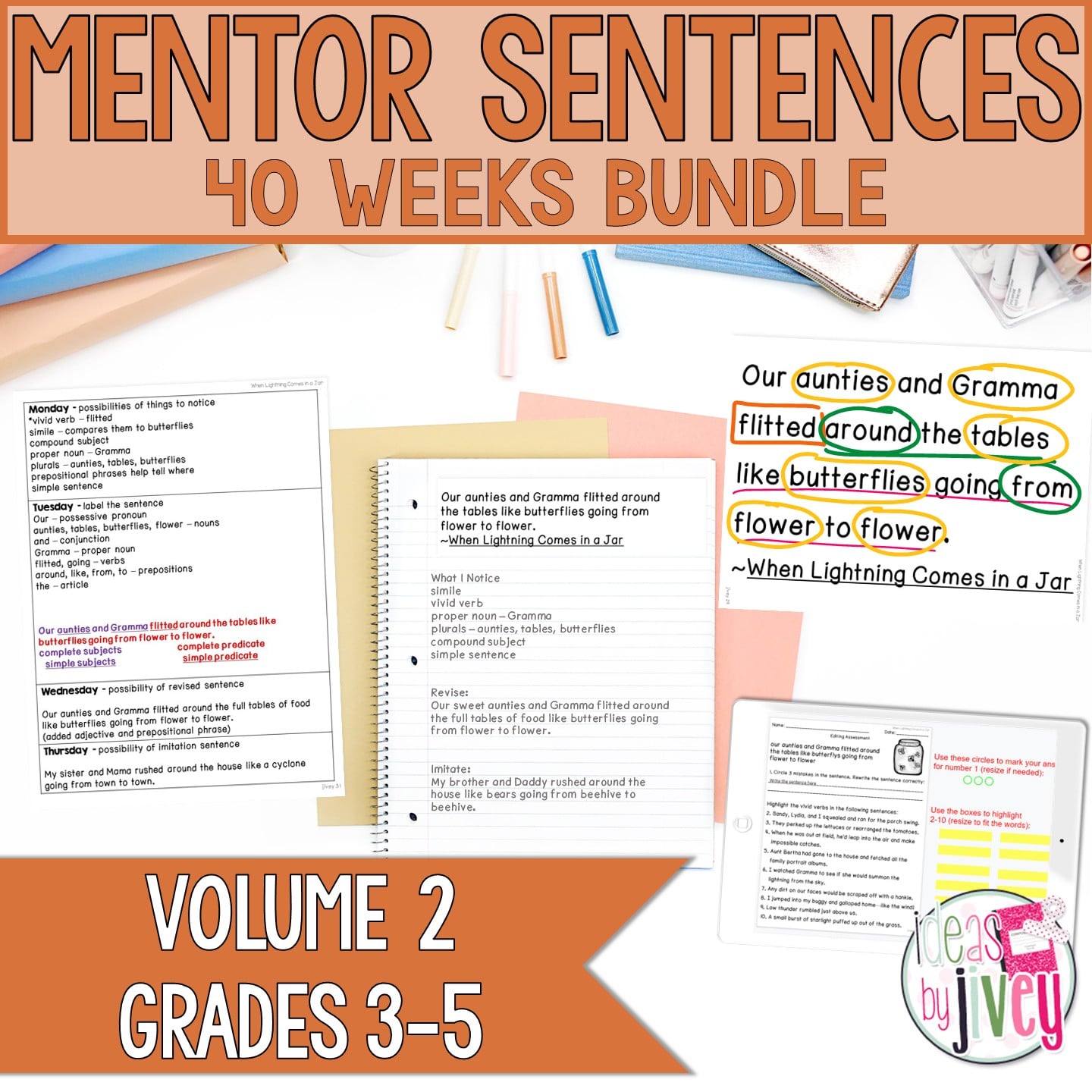
These mentor sentences give you a full year of daily grammar lessons: all four Volume 2 units in one bundle, each week built on one sentence from a popular picture book or nonfiction read-aloud, like The Name Jar, The Day the Crayons Quit, Snowflake Bentley, and Owls by Gail Gibbons.
Each day, students spend 10 to 15 minutes with the same sentence, working with it in a new way: noticing, labeling, revising, and writing their own. You don’t need to be a grammar expert to teach it. I’ve already done the thinking for every day, right down to sample revisions and imitations, so you can open the lesson plan and go!
The books are not included. I chose favorite read-alouds that most school libraries already have.
Unit 1 (best at the beginning of the school year)
Unit 2 (best in November, December, and January)
Unit 3 (best from the middle to the end of the year)
Unit 4 (nonfiction, any time of the year)
Fix-the-sentence drills hand students a sentence full of mistakes. If they don’t already know the rule, they can’t spot the errors, and fixing someone else’s mistakes doesn’t show them what a strong sentence looks like. That’s why the practice so rarely shows up in their own writing.
Mentor sentences flip that! Each week starts with a model sentence from a published author, and students soak up the grammar by noticing it, talking about it, and trying it in a sentence of their own. They pick up craft along the way, too: figurative language, descriptive words and phrases, and sentence variety they can borrow for their own writing.
Research backs up teaching grammar in context instead of in isolation. A large review of writing studies for grades 4 to 12 found that grammar taught in isolation did not improve students’ writing (Graham and Perin, 2007).
The routine stays the same every week, so students of any ability know exactly what to expect. Each week focuses on one or two skills, but students also meet new and earlier skills in every sentence, and that spiral review keeps them in front of students all year!
New to mentor sentences? My Mentor Sentences for 3-5 page walks through how they work in upper elementary.
I put Units 1 to 3 in the order I taught them, so the skills spiral and get harder as the year goes on. Unit 4 adds nonfiction books you can use any time of the year to spread nonfiction through your teaching. You don’t have to follow the unit order. The included At-A-Glance lists every book and skill in the volume so you can plan out your year.
Volume 1 and Volume 3 use different books, so teachers in different grades at the same school don’t repeat lessons.
This purchase is for one teacher. Please don’t share the files with other teachers. Thank you!
Copyright © 2015 Ideas By Jivey, LLC
All rights reserved by author.
Permission to copy for single classroom use only.
Electronic distribution limited to single classroom use only.
Not for public display.
Thank you. Your review was received and will appear once it has been checked.
Please log in to the account you used to buy this resource. Only customers who bought it from this shop can leave a review.
Growth off of the charts!
Using this resource everyday helps students actually know the skill and how to use it daily. It doesn't teach in isolation, so the kids don't forget. Highly recommend to all my fellow teachers!
Amazing resource!
This is an excellent resource to use when spiraling the grammar skills! The students love the routine!
Good Resource
Good practice for students to review grammar and writing sentences.
A well crafted resource
I loved everything about this resource. Students were engaged and had fun learning.
Wow! Amazing!
Thank you so much for creating this resource! It’s so thorough!
valuable resource
These mentor sentences have been a game changer in my classroom! They have helped my students better identify the parts of speech in sentences while also improving their writing skills.
Great Resource
I love using mentor sentences in my classroom--thank you!
Easy to Follow and Great
Wow, this is a great way to slide in a writing and grammar combo. I use this every-other-week with the class.
Thorough and thoughtful
I love this bundle to use with mentor sentences, it’s very organized and thorough. Thank you!
I absolutely love these mentor sentences and used them every day! I purchased all of the available sets for this grade so that I could use them all year long!
My students use this resource every morning for morning work. I am excited to see how it benefits them through the year.
I have been doing mentor text for about 2 years now and I love it! My kids understand parts of speech and types of sentences because I do it everyday! I bought this one to have some more book options. It opens their eyes to make sentences "juicier" (to add more description) and to be creative in their own sentences. I do move slow in the beginning and do a boot camp style of parts of speech before diving into this. After that, we take off!
I just cannot say enough about Ideas By Jivey! I use this in conjunction with the mentor text bundle for volume 2. I love that my reading, grammar, and writing lessons fit so seamlessly together.
I have had the original resource for a while now and needed to revamps. This is one of my favorite resources.
This has made learning grammar so smooth and seamless. The exposure to new books each week was great. It included a nice variety.
Students were engaged with the books that went along with the resource each week.
These grammar mentor sentences are a fabulous way to make students analyze grammar in a real world way. A much needed addition to my English lessons!
I have been using Jivey's Mentor Sentence resources for over six years and love them. Since using them while teaching 3rd, 4th and now 5th grade, I have seen engagement go way up and students' understanding of grammar concepts go way up as well. It's easy to learn the routine and implement with students. The concepts spiral and the students gain confidence and proficiency with each passing week of use. Thank you, Jivey!
This is one of my favorite resources. I had the original pack and recommended it to my grade level. Then I switched grade levels and the first thing I bought was this set ! Thank you!
I love using the mentor sentences with my students! It provides language skills while using quality literature!
We love mentor sentences! Thank you for putting together such a thoughtful collection! I have recommended this to many colleagues!
This is a great resource for my ELLs to work on understanding the topic!
I saw other teachers use it and how students were engaged. I bought my own one and used it with my students. They LOVE it! Thank you
I found this resource to be really helpful in my class, however there was a bit of planning and organizing that has to happen before ever using it. I never used mentor texts or sentences before so there's been a bit of a learning curve for me, but it is an excellent resource, especially if you are someone who is familiar with this already.
I used volume 1 last year, and since I have students for 2 years, I couldn't wait to get volume 2. It really engages my students. They know what to expect each week, and are much better at identifying the parts of speech. They love getting to write their own sentences to model after the mentor sentence.
My students love mentor sentences. They love the repetition and independent nature of mentor sentences and the interactive read alouds of a different book each week.
Very helpful and engaging resource to add to my classroom!
Really enjoyed using Volume 1 this year, so made sure to pick up 2 and 3 as well. Very easy to get running and keep going over the year, with a lot of flexibility in the texts if you want to move things around.
I love the amount of work the creator put into this resource and the general idea of it. I rated 4/5 stars because some of the texts are quite outdated and not something I want to read to my class. Given the age group, I think using chapter books for a couple of weeks (instead of a new picture book each week) would also be more beneficial for the students.
I love this resource as a quick 15-minute grammar lesson! It is a great warm-up for writing, so grammar isn't taught in isolation. Then, students can apply their knowledge to our writing lessons, as well. I also love the recording sheets for the notebook, so we aren't waiting for students to write the whole sentence.
This can be confusing at first but once you get the hang of it, the students really enjoy it.
This is the third of these bundles that I have purchased. I love using these with my students. I don't always know all of the books but I have found some I didn't know that are now favorites. Students love hearing the stories and pulling sentences from the book to use to build sentence knowledge. I highly reccomend!
Great resource for implementing mentor sentences into students daily routine! LOVE THIS RESOURCE!
I love using mentor sentences and was excited to add this volume.
This is a great resource for reinforcing grammar skills. My students quickly became familiar with the routine and are much better at different parts of speech now!


